
The Essential-Expense Borrowing Journey
A practical look at the budget gaps behind the 37% finding - and how consumers can compare borrowing options with greater clarity.
Borrowing money is often associated with a major emergency or a large purchase. Yet for more than one in three Americans in the Cashback Loans survey, the reason was more routine: paying for essential living costs during the previous 12 months. The 37% result points to a gap between when income is available and when necessities must be paid.
That gap may be temporary, seasonal, or recurring. A utility bill may rise during extreme weather. A vehicle repair can compete with groceries. Rent may be due several days before a paycheck. In other cases, everyday expenses may consistently exceed income. Understanding which type of gap exists is the first step toward choosing an appropriate response.
The borrowing journey in four questions
What created the need?
A one-time expense, a due-date mismatch, a seasonal increase, or an ongoing monthly shortfall may all lead to borrowing - but they require different plans.
Which resources were available?
Survey borrowers used relatives, credit cards, friends, payday or cash-advance services, Buy Now Pay Later, and bank personal loans. Many selected more than one.
What would repayment change?
The right comparison includes the repayment date and the effect of that payment on rent, utilities, food, transportation, and other essentials.
Is the solution temporary or sustainable?
Short-term credit can address a defined timing gap. A deficit that repeats every month usually calls for changes to income, recurring costs, or bill arrangements.
Borrowing was not limited to one source
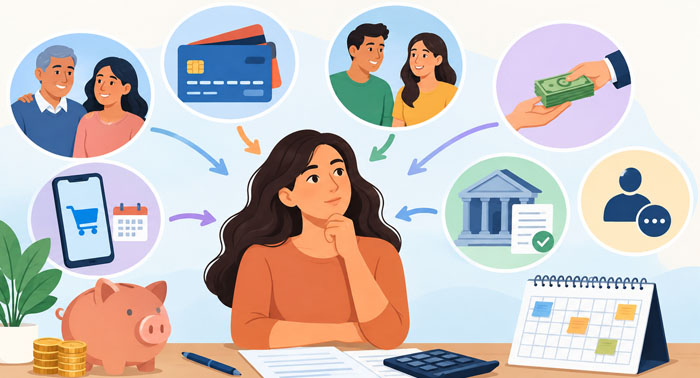
Among the 1,110 respondents who borrowed for essentials, 42% borrowed from relatives, 35% used credit cards, 34% borrowed from friends, 23% used a payday loan or cash-advance service, 18% used Buy Now, Pay Later, and 17% used a bank personal loan. Another 3% selected another method. Because respondents could select multiple sources, these percentages exceed 100%.
| Borrowing source | Share | What to clarify |
|---|---|---|
| Relative | 42% | Repayment timing and expectations |
| Credit card | 35% | Available credit and payment schedule |
| Friend | 34% | Amount, timing, and communication |
| Payday/cash advance | 23% | Total repayment, due date, and funding timing |
| Buy Now, Pay Later | 18% | Installment dates and overlapping plans |
| Bank personal loan | 17% | Term, payment amount, and eligibility |
The mix shows that borrowers assemble solutions from the resources available to them. Personal relationships were the most common sources, while formal and retail credit products also played meaningful roles. The best fit depends on the amount needed, timing, eligibility, privacy preferences, repayment schedule, and whether the arrangement is clearly understood by everyone involved.
Using more than one source can also change the repayment picture. A household might put groceries on a credit card, borrow part of a utility payment from a relative, and use another product for transportation. Each decision may solve one immediate problem, but the combined due dates can place pressure on the next paycheck. Consumers benefit from writing every obligation in one place - even informal arrangements - so the total commitment is visible before another source is added.
Why everyday essentials can require borrowing

The wider survey helps explain the 37% figure. Rising living costs were a leading financial concern for 53% of respondents. Forty-two percent had cut back on groceries, 25% had used savings for everyday expenses, 20% had missed or delayed a bill, 21% had delayed medical or dental care, and 16% had taken a second job or side hustle. These percentages come from different survey questions and should not be added together, but collectively they show how households are adapting.
Essential expenses are difficult to postpone indefinitely. Housing, utilities, food, gas, insurance, and necessary healthcare support daily life and employment. When several increase at once, a household can run short even if income has not changed. Borrowing may then function as a bridge between a required payment and future income.
Timing is especially important for workers with fluctuating hours, commission income, seasonal employment, or payment schedules that do not match monthly due dates. The same can be true for households waiting for a reimbursement, benefit payment, tax refund, or support payment. In these situations, the budget may have enough expected income overall while lacking cash on the exact day an essential bill is due. Identifying the expected inflow and its reliability helps determine whether a short bridge is workable or whether a bill arrangement would provide a better match.
Myth versus reality: understanding the 37%
Borrowing for essentials always follows poor planning.
Reality: A budget can be carefully managed and still be disrupted by timing, cost changes, irregular income, family responsibilities, or an urgent expense.
One product is automatically best for everyone.
Reality: The appropriate option depends on eligibility, speed, total repayment, due date, amount, privacy, and the consumer's next budget cycle.
The amount borrowed is the only number that matters.
Reality: Consumers also need to know the amount they receive, fees, total repayment, repayment method, and when funds and payments are expected.
How to evaluate payday-related search results

Consumers searching for a payday advance or payday advance online loans may encounter many sites with similar language. A useful first step is to determine whether the site belongs to a lender, a marketplace, or an information publisher. Working with direct lender loans means the company receiving the application also manages the lending process rather than simply matching the consumer with another provider.
Search phrases such as "best payday loans" and "best payday loans online" should be treated as comparison prompts, not universal rankings. "Best" may mean the clearest terms, a convenient application, accessible customer support, an appropriate repayment date, or funding that aligns with the consumer's need. The answer can differ from one borrower to another.
A thoughtful search comparison can begin with several concrete checks. Is the lender licensed where the consumer lives? Does the website clearly identify the business and provide contact information? Are the amount, fee, total repayment, due date, and repayment method disclosed before an agreement is accepted? Can the borrower reach customer support with a question? Does the product amount match the actual need, or would it encourage taking more than necessary? These questions turn a broad search phrase into an evaluation based on the consumer's own circumstances.
The phrase "payday quick cash loans" often reflects urgency, but speed should be considered alongside the lender's identity, eligibility requirements, amount available, funding method, customer support, and published rates and terms. Consumers seeking same-day emergency cash options should also confirm what "same day" means, because approval and funding timing can vary by applicant, bank, application time, and funding method.
A borrower's comparison worksheet
| Question | What to record |
|---|---|
| What expense must be covered? | Essential purpose and exact due date |
| How much is actually needed? | Minimum amount that closes the gap |
| When is income available? | Expected deposit date and certainty |
| What is the full repayment? | Principal, fees, due date, and method |
| What alternatives are available? | Savings, payment plan, extension, family, bank or credit union |
| What happens next month? | Essential bills remaining after repayment |
The worksheet separates an immediate need from the decision about how to fund it. Before borrowing, consumers can also contact the biller, compare payment arrangements, review available savings, and consider support from family or a bank or credit union. If borrowing is selected, the amount should fit a clear repayment plan without displacing essential expenses due at the same time.
It can also help to create a "day after repayment" budget. Start with the income expected on the repayment date, subtract the full payment, and then list every essential expense due before the following paycheck. If the remaining amount cannot cover those needs, the proposed arrangement may simply move the same gap forward. Revisiting the amount, due date, or alternatives before accepting an agreement can produce a clearer plan and reduce surprises in the next cycle.
What the finding means for 2026
The fact that 37% of Americans borrowed for everyday essentials does not point to one type of borrower or one financial product. It shows that essential-cost pressure is common enough to cross many household situations. Some people used personal networks, some used revolving or installment credit, some used payday or cash-advance services, and many used more than one source.
The most useful response is informed comparison. Consumers can identify whether the gap is temporary or recurring, clarify the amount and timing, review every repayment obligation, and choose among available resources. When the need is specific and repayment is workable, short-term borrowing can be evaluated as one tool within that broader decision - not as an automatic answer to every essential expense.
Methodology note
Source: Cashback Loans Results Tables. The total sample was 3,000 respondents. The borrowing-method question was asked of the 1,110 respondents who said they had borrowed for essential living costs during the previous 12 months and allowed multiple responses. Percentages are rounded. Results describe reported attitudes and behaviors and do not establish cause and effect.