
Using Savings vs Borrowing
- Date published: October 05, 2026
-

Written by
-

Reviewed by
How households can compare savings, credit, personal support, and short term borrowing when an expense cannot wait.
Table of Contents
- Introduction
- The survey picture at a glance
- Start with the expense before choosing the source
- How to evaluate payday loan search terms
- The one pay cycle decision sheet
- A borrower's comparison worksheet
- Methodology note
Introduction
An unexpected expense creates two immediate questions: where can the money come from, and what will that choice change afterward? Cashback Loans survey data shows why both questions matter. Forty-four percent of Americans reported having no emergency savings. Among those who did have savings, 17% had less than $1,000, while the average balance among savers was $27,249. At the same time, 37% of all respondents said they had borrowed for essential living costs during the previous year.
These findings do not divide consumers neatly into "savers" and "borrowers." A person may have savings but preserve part of it for rent or another near-term need. Another may use savings for part of a repair and borrow the remainder. Someone with no reserve may compare family help, a credit card, a payment arrangement, or a payday advance. The useful decision is the one that fits the amount, timing, and next household budget.
The survey picture at a glance
| Finding | Who it covers | What it tells us |
|---|---|---|
| 44% | All 3,000 respondents | Reported having no emergency savings |
| 17% | The 1,688 respondents with savings | Reported an emergency fund below $1,000 |
| $27,249 | Respondents with savings | Average reported emergency fund in the saver subgroup |
| 37% | All 3,000 respondents | Borrowed for essential living costs in the previous year |
The $27,249 average should not be treated as a required target or a typical balance. It applies only to respondents who had savings, and larger accounts can raise an average. The 44% without an emergency fund and the 17% of savers below $1,000 show that many households approach an unexpected expense with a much smaller cushion—or none at all.
Start with the expense before choosing the source
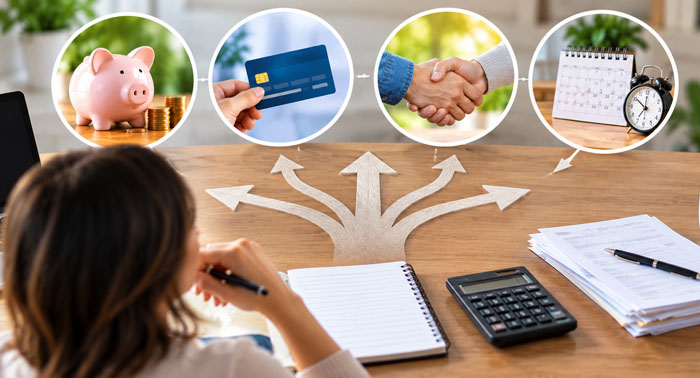
Before deciding whether to use savings or borrow, define the problem in concrete terms. What must be paid? What is the minimum amount that resolves it? When is it due? Is future income already scheduled, and how certain is that deposit? An urgent car repair needed for work may require a different response from a bill that can be moved by several days.
Next, separate a temporary timing gap from an ongoing monthly shortfall. If income is expected shortly and covers the expense plus the rest of the pay cycle, savings or short-term borrowing may bridge a specific gap. If essential costs exceed income every month, any one source may provide temporary relief while the underlying budget still needs attention. That distinction shapes all four pathways below.
PATH ONE Use savings and keep the decision simple
Savings can cover an expense without creating a future repayment date. That makes the choice easy to track: money leaves the emergency fund, the bill is resolved, and the next task is rebuilding the reserve. For households with enough set aside, using savings may be a direct match for the reason the fund exists.
The full balance does not have to be available for every emergency, and using all available savings is not always necessary. Consumers can look ahead at rent, utilities, groceries, insurance, transportation, and medical needs before deciding how much of the reserve to use. Keeping a small operating cushion in the account may help prevent the emergency solution from creating a new shortage a few days later.
A rebuilding plan can begin immediately, even if the deposit is modest. The household can choose an amount tied to each paycheck, redirect money from a temporarily reduced expense, or schedule a transfer after the next major bill clears. The goal is to restore a useful buffer at a pace the regular budget can support.
PATH TWO Borrow and preserve available cash
Borrowing may be considered when savings are unavailable, too small, or needed for another essential obligation. The survey shows that borrowers used several routes: among the 1,110 people who borrowed for essentials, 42% borrowed from relatives, 35% used credit cards, 34% borrowed from friends, and 23% used a payday loan or cash-advance service. Respondents could select more than one method.
The sources differ, but the comparison questions are similar. How much cash will be available? When will it arrive? What is the full repayment commitment? When is payment due? How will that payment interact with the next round of essential bills? Informal help also benefits from clear expectations, while credit products should be reviewed through their disclosures and account terms.
Consumers considering a payday advance can compare the amount received, fee, total repayment, due date, and repayment method before accepting an agreement. When reviewing payday advance online loans, confirming that the website belongs to the lender and that the lender serves the consumer’s state helps turn a broad search into a more specific evaluation.
PATH THREE Combine savings and borrowing
A blended approach may fit when savings can cover part of the expense but using the full reserve would leave too little for other immediate needs. For example, a household might use part of its savings for a vehicle repair and borrow only the remaining amount. Reducing the amount borrowed can change the repayment commitment, while retaining some savings preserves cash for groceries, gas, or another scheduled bill.
The key is to view both sides as one plan. Write down the savings withdrawal, the amount borrowed, the full repayment, and the bills due before and after that payment. Without a combined view, a household may focus on the smaller loan amount while overlooking how much cash was also removed from the reserve.
This approach can also be paired with a rebuilding schedule. Once repayment is complete, the amount that had been directed toward the obligation can be reconsidered as a savings deposit. The timing may need to change, but connecting the two phases helps turn an emergency response into a recovery plan.
PATH FOUR Use an arrangement that changes the due date
Sometimes the most useful option is not a new source of cash but a change in timing. A utility provider, medical office, landlord, insurer, or service company may offer a payment arrangement, extension, or split payment. The consumer can ask what is available, whether a fee applies, and how the arrangement will appear on future bills.
A timing change can be used alone or alongside savings or borrowing. If moving a due date closes the entire gap, the household may not need another source. If it solves only part of the problem, the revised amount and date make the remaining need easier to calculate. The important point is to obtain clear confirmation rather than assuming a payment can be delayed.
How to evaluate payday loan search terms
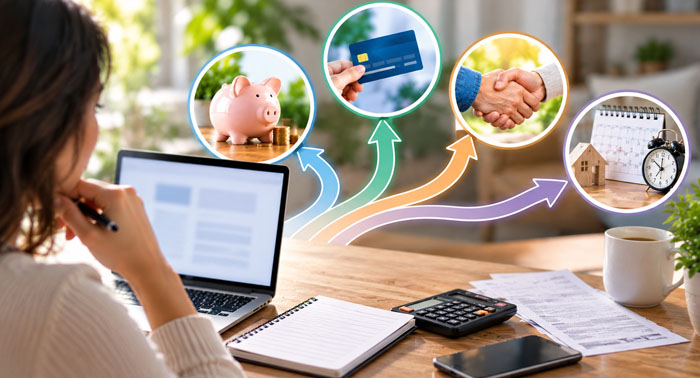
Search phrases such as "best payday loans" and "best payday loans online" do not identify one universal choice. "Best" depends on the consumer’s location, eligibility, amount needed, application preference, funding method, customer support needs, and repayment date. A useful comparison replaces a general ranking with a checklist tied to the actual expense.
The phrase "payday quick cash loans" usually signals that timing matters, but funding speed should be reviewed alongside the lender’s identity, disclosures, contact information, available amounts, and published rates and terms. Approval and deposit timing can vary by applicant, application time, bank, and funding method. Cashback Loans provides information about online payday loan options and a direct online application for eligible California consumers.
The one pay cycle decision sheet
| Decision point | Savings view | Borrowing view |
|---|---|---|
| Amount | How much can be used while preserving essential cash? | What is the minimum amount needed? |
| Timing | When can the reserve be rebuilt? | When will funds arrive and repayment occur? |
| Next bills | What expenses remain after the withdrawal? | What expenses remain after repayment? |
| Documentation | Record the withdrawal and rebuilding transfer | Review disclosures or document an informal agreement |
| Follow through | Schedule the next savings deposit | Set repayment reminders and confirm completion |
The decision sheet puts savings and borrowing on the same timeline. It helps consumers compare what leaves the household today, what must be paid later, and what remains for essential expenses. A blended approach can be recorded in both columns, while a payment arrangement can be added by changing the due date and recalculating the remaining need.
There is more than one workable response

The survey data shows why unexpected expenses require flexible thinking. Many Americans have no emergency fund, some savers have only a modest balance, and more than one in three respondents borrowed for essentials. Those facts can exist within the same household over time: a person may save in one month, use that reserve in another, and borrow when the next expense is larger than the cash available.
The strongest decision starts with a defined expense and ends with a realistic next-pay-cycle budget. Savings, borrowing, a blended plan, and a payment arrangement each change cash flow in a different way. By comparing the minimum amount needed, the timing, the full commitment, and the expenses that follow, consumers can choose an option that fits the immediate need and the household calendar.
Methodology note
Source: Cashback Loans Results Tables. The total sample was 3,000 Americans. The emergency-savings balance and $27,249 average apply to the 1,688 respondents who reported having emergency savings. The borrowing-method question was asked of the 1,110 respondents who borrowed for essential living costs and allowed multiple answers. Percentages are rounded and describe reported behavior; they do not establish cause and effect.